 SilencerScout
The Booster (Nielsen Device)
Start here. This mechanism makes everything else make sense. Almost every modern striker fired pistol runs a Browning style short recoil action: when you fire, the barrel and slide recoil locked together for a fraction of an inch, then the barrel tilts down and unlocks, letting the slide continue back to eject, cock, and strip a fresh round. That unlocking is driven by momentum. Now hang 6 to 12 oz of suppressor off the muzzle and the barrel becomes much heavier and the gun might short stroke: fail to eject, or fail to feed.
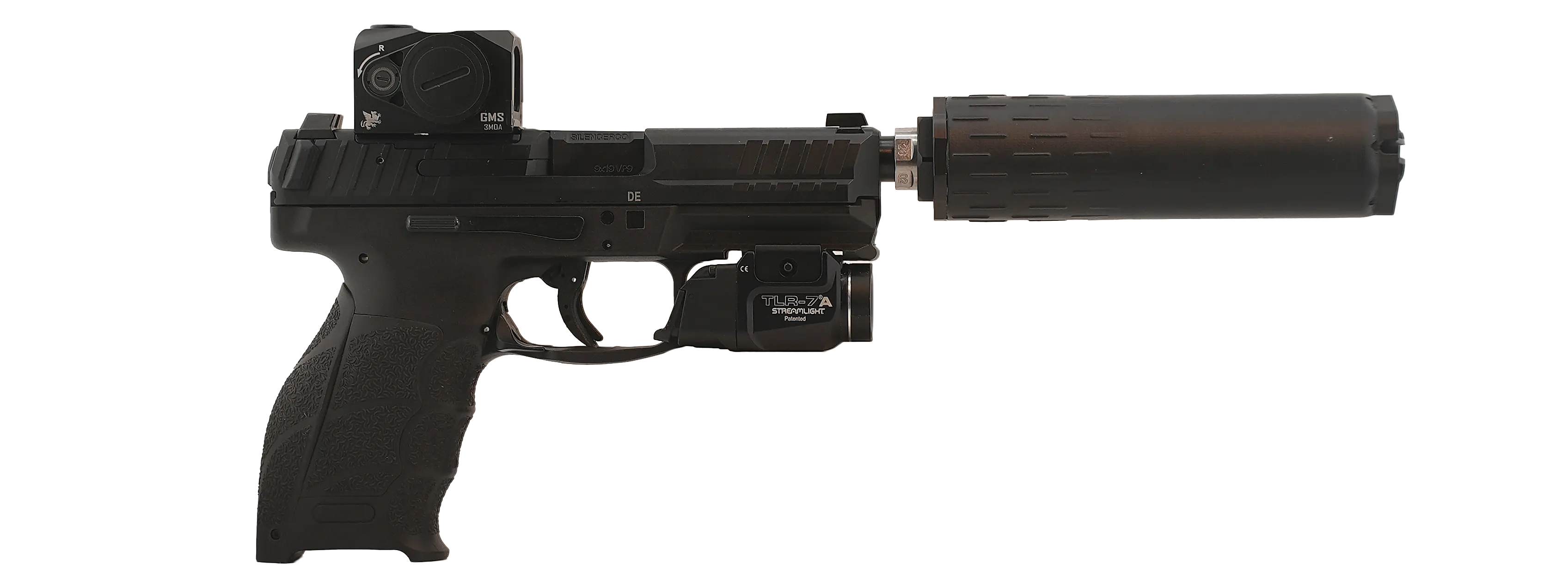
The fix is a Nielsen device, also called a recoil booster or, in Dead Air's naming, a LID (Linear Inertial Decoupler). It is a spring-loaded piston that mounts the suppressor to the barrel while letting the two briefly move independently. The piston lets the barrel take its initial rearward run and unlock before the mass of the can gets dragged along, decoupling the suppressor's weight from the barrel just long enough for the action to do its job.
Something to look for when shopping for a handgun suppressor, does it ship with a booster assembly? If they do not it could be for two reasons, to save you money in case you already own one, or because they are direct thread pistol cans and are not compatible with booster assemblies. Check out our article on booster-less pistol suppressors for more insight into these.
Threaded Barrel
This one might go without saying, but if your barrel does not come threaded from the factor it is worth checking to ensure there is an aftermarket solution for adding a threaded barrel before selecting a suppressor.
Thread pitch is the detail people trip on. The de facto standard for 9mm is 1/2x28. Larger bores change the pitch: .45 ACP is usually .578x28, and .40 caliber is often 9/16x24. A number of pistols, especially those with European roots, use metric threads like M13.5x1 LH. Match the piston on your booster to the thread on your barrel.
The Suppressor
On a pistol, two numbers matter more than they do anywhere else: weight and outer diameter. Everything hanging off the muzzle is weight the booster has to overcome, so a lighter can is a can that cycles more reliably and points more naturally. This is where modern titanium suppressors have become a main stay on my handguns. Some larger, heavier stainless suppressors will often work just fine, but the weight is only suitable for short range sessions.
Outer diameter is the other constraint. The outer diameter of the suppressor will set a minimum height over bore required by your optics. These days, the solution is to add a red dot or extended high iron sights to clear the can itself. See our chapter on suppressor diameters to understand why they don't make really thin suppressors for handguns. What they do make, is eccentric bore suppressors like the SilencerCo S98 that will sit under most factory sights. This is done by shifting the suppressor bore up to the top of the blast chambers, setting the center of mass well bellow the bore axis. These are cool options if you don't have options for optics cut slides or suppressor height sights. Or if you just like the look, that is reason enough to consider one.
Recoil Spring
With a good booster doing its job, many pistols will run suppressed on their factory recoil spring and never ask for more. But "many" is not "all."
The logic is the same tuning problem as buffer weight on a rifle. The recoil spring resists the slide: too heavy and a weak subsonic load cannot cycle it, too light and a hot supersonic load slams the slide harder than it needs to.
The honest caveat is that this is a semi-permanent adjustment tuned to one recipe. Set the spring soft for subsonic 147 gr and your supersonic carry loads may start ejecting erratically, and vice versa. For most people the order of operations is: get the booster and barrel right first, shoot the gun, and only chase spring weight if you have a cycling problem you can actually feel. Plenty of shooters never touch it.
Subsonic and Supersonic
We cover the mechanics of subsonic versus supersonic ammo in depth elsewhere, so here we will keep it short and practical. Look into your specific model of handgun. Some will play nicely with subsonic ammo, and some might need their spring weight tinkered with. It is worth digging into a bit, because if you have a suppressed handgun, you will want to shoot subsonic ammo at some point.